Dust, or airborne particles, consists of minute particles that can remain freely suspended in the air and distributed over long distances. Such particles are 100 µm in size or smaller, i.e. one tenth of a millimetre. However, larger particles which are not airborne can also be considered dust. Dust is generated in a number of various industries, such as the woodworking, metal-working, cement manufacturing, mineral wool manufacturing and plastics industries.
Absolent focuses on dealing with dust that is generated in the engineering industries. The following are typical operations that generate dust:
- Welding
- Laser and plasma cutting
- Dry grinding
- Sand blasting
- Painting
In short: most operations that handle, machine or process dry materials.
Risks and Discomfort
Dust particles have acute effects on a person's respiratory passages. Worst affected are elderly people and persons with respiratory diseases.
The particles may be carcinogenic in themselves but they may also be carriers of carcinogenic substances.
Several factors contribute to the hazardousness of dust, for example the particle size, type of dust and type of accompanying substances in the dust.
Inhaled particles larger than 10 µm normally get caught in the cilia inside the nose and do not reach the lungs. Particles between 2.5 and 10 µm generally seat themselves in the upper respiratory tract where they can cause or aggravate asthma, pneumonia and bronchitis. Several studies have shown a connection between increased particle content in the air and an increasing frequency of deaths and hospital admissions. The effects on health can be broken down into three groups: diseases of the respiratory tract, cancer and cardiovascular diseases.
Dust emissions have impact on the environment in the form of dusting and air pollution. Furthermore, dust may carry poisonous substances such as heavy metals and organic environmental toxins. These in turn have an impact on both the soil and water in different ways.
Dealing with Dust
A number of conditions must first be considered for the evaluation of a suitable air purification technique and for choosing a cost-efficient solution. Typical conditions to be considered are airflows, dust content, type of dust, where contaminants arise, etc.
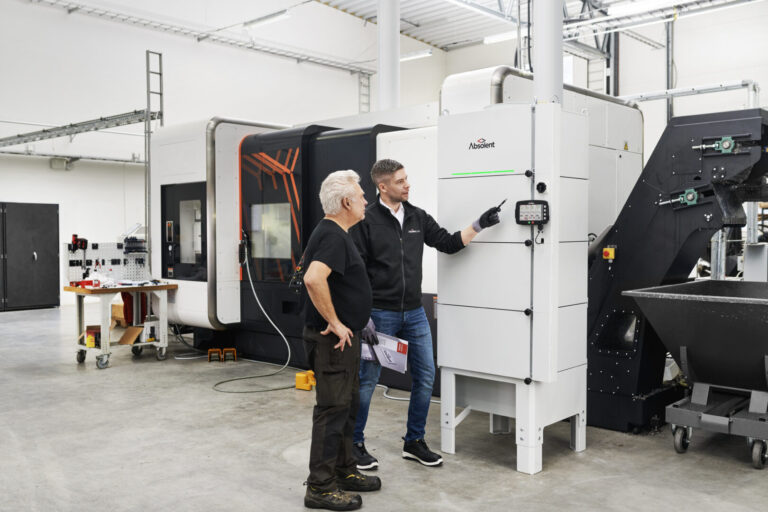
Air purification involves the separation of particles from the air. Dust extraction hoods or direct dust extraction on enclosed machines are commonly used and this involves conveying air containing impurities to a dust filter where the air is purified. The air is then discharged into the premises or to the open air outside. Because, in most cases, this involves large airflows, heat exchangers are generally used for recovering heat from the purified air as a means of reducing power consumption.
Textile filters, such as pleated cartridge filters, have a high dust collecting efficiency, as much as 99% or more in many cases and their efficiency for collecting small particles is also high. The performance of filters depends on a combination of several factors: filtering capacity, diffusion, forces of inertia, etc. Textile filters are well suited for arresting particles of 1 – 100 µm in size.
Reference:
Länsstyrelsen Västra Götalands Län. (The County Administrative Board of Västra Götaland County) Rapport 2004: 56, Partiklar och Stoft – en kunskapsöversikt. (Particles and Dust – A Knowledge Survey)
ISSN 1403-168X, Version 2004-05-24